
Claude training · for teams and builders
Claude training for businesses: from chat to Projects and Skills
A hands-on Claude workshop for your team. You learn to prompt on your own work, set up a Project with your knowledge, build a Skill for work that comes back every week and, if you want to build, take your first steps with Claude Code. On site, for € 4,500 per half day.
- Workshop € 4,500 per half day
- We build with Claude ourselves
- Rated 9.3
Claude · project Quotes 2026
liveopens project 'Quotes 2026': price list, terms and 12 earlier quotes
loads skill 'quote-in-house-style'
creates quote-jansen.docx in the house style
Trusted by






















01 / Who it's for
Who is Claude training for?
For teams that already use Claude or are considering it, and want to go beyond one-off questions. Claude is Anthropic's AI assistant. In our experience it's strong at writing, at analyzing long documents and at tasks that take several steps. How it compares with other models on real office work is something we measure ourselves in our benchmarks.
We work with Claude a lot ourselves: to write, to analyze and to build. So what we show in the training is what we actually use. Including the things that fall short.
The training suits three kinds of teams. Teams that produce a lot of text: quotes, reports, policy documents, customer emails. Teams that have to read and compare a lot of documents. And people who want to build something themselves, without being a developer.
01Teams with Claude Team or Enterprise
The licences are there. Now for the Projects and Skills that really speed up the work.
02Writers and analysts
Quotes, reports, contracts and research: lots of text, lots of sources.
03Builders and advanced users
Anyone who wants to make their own tools, scripts or prototypes with Claude Code.
04Still undecided
Haven't chosen yet? Compare ChatGPT, Copilot and Claude first.
02 / Four levels
From a one-off chat to building it yourself.
Claude is more than a chat window. Most teams only use the first level. In the training we go as far as your group can handle.
- 01
Chat
For everyone
Good prompting: context, examples and a clear format. Having PDFs, Excel files and long documents read and compared.
- 02
Projects
Per team or client
A fixed place with instructions and files. Claude knows the price list, the terms and earlier documents, and you share it with your team.
- 03
Skills
For recurring work
A folder with instructions, examples and optionally scripts that Claude loads by itself when a task calls for it. The quote in house style, right every time.
- 04
Claude Code
For those who build
Claude writes, tests and adjusts code in your own project. From a handy script to a prototype of an internal tool.
03 / What you learn
What you learn in a Claude workshop.
Half a day of three to four hours, with 6 to 15 participants and a laptop per person. Everyone works with their own examples and goes home with a Project or Skill they can use straight away.
Writing in your tone
Prompting with context and examples, so a customer email or report sounds like you, not like a robot.
Setting up a Project
Per client, team or process: which files and instructions belong in it, and how to share it with colleagues.
Building your first Skill
A Skill for work that comes back every week. With Anthropic's built-in skill-creator, so without programming.
Working with Office files
Claude creates and edits Excel, Word, PowerPoint and PDF files. Handy, and that's exactly why you check what comes out.
Checking the output
Where Claude is strong, where it makes things up with conviction, and how to check the sources quickly. A human decides.
Claude Code for builders
For those who want to: building a first tool or script, with a plan you approve first. Building without being a developer.
04 / Skills in practice
Skills that teams build in the workshop.
A Skill is essentially a work instruction that Claude reads by itself. Useful for everything you currently explain to every new colleague. A few examples that come up often:
Sales
Quote in house style
Layout, line items from the price list, the right terms and the logo in the right place.
Operations
Meeting to action list
Notes or a transcript turned into decisions and action items, per person, in your format.
Customer service
Replies in your tone
How you address customers, what you do and don't promise, and when you refer them on.
Finance
Monthly report from Excel
The same analysis and the same charts, every month, from a new export.
05 / Plans
Which Claude plan does your business need?
For work with company data, you want a business plan. Anthropic's commercial terms apply there: your prompts and files aren't used to train models. Prices and exactly what's included per seat change regularly; we check them together with Anthropic beforehand.
| Personal (Free, Pro, Max) | Claude Team | Claude Enterprise | |
|---|---|---|---|
| Intended for | One person | Teams | Larger organizations |
| Conversations used to train models | Possibly, unless you turn it off | No | No |
| Sharing Projects with your team | · | ✓ | ✓ |
| Skills | Pro and Max | Yes, can also be enabled centrally | Yes, can also be enabled centrally |
| Claude Code | Pro and Max | Depends on the type of seat | Depends on the type of seat |
| Central user management | · | ✓ | ✓ |
Swipe sideways to see all columns →
Sources: Anthropic on Skills (October 2025), the consumer terms (2025) and data use under the commercial terms. Features per plan change; check the current situation with Anthropic.
06 / Claude Code
Claude Code: what do you learn if you want to build?
Claude Code is Anthropic's tool that lets Claude write, run and adjust code independently in your own project. For developers, that's a serious speed-up. For advanced users without a programming background, it opens a door: making a script, an integration or a prototype of an internal tool yourself. That's also known as vibe coding.
In the advanced part of the training you learn to:
- Describe a task well, so Claude first makes a plan that you approve
- Take small steps and test each one
- Work in a folder of your own project, without real customer data
- Recognize when a prototype is ready to share, and when it isn't
An honest warning belongs here too. A prototype on your own laptop is something different from software that customer data runs through. Security, error handling, maintenance and integrations are the real work. Many teams have a prototype that never got further than one laptop. Making that production-ready is what we do in the AI Partnership.
07 / Human in the loop
First the plan, then the execution.
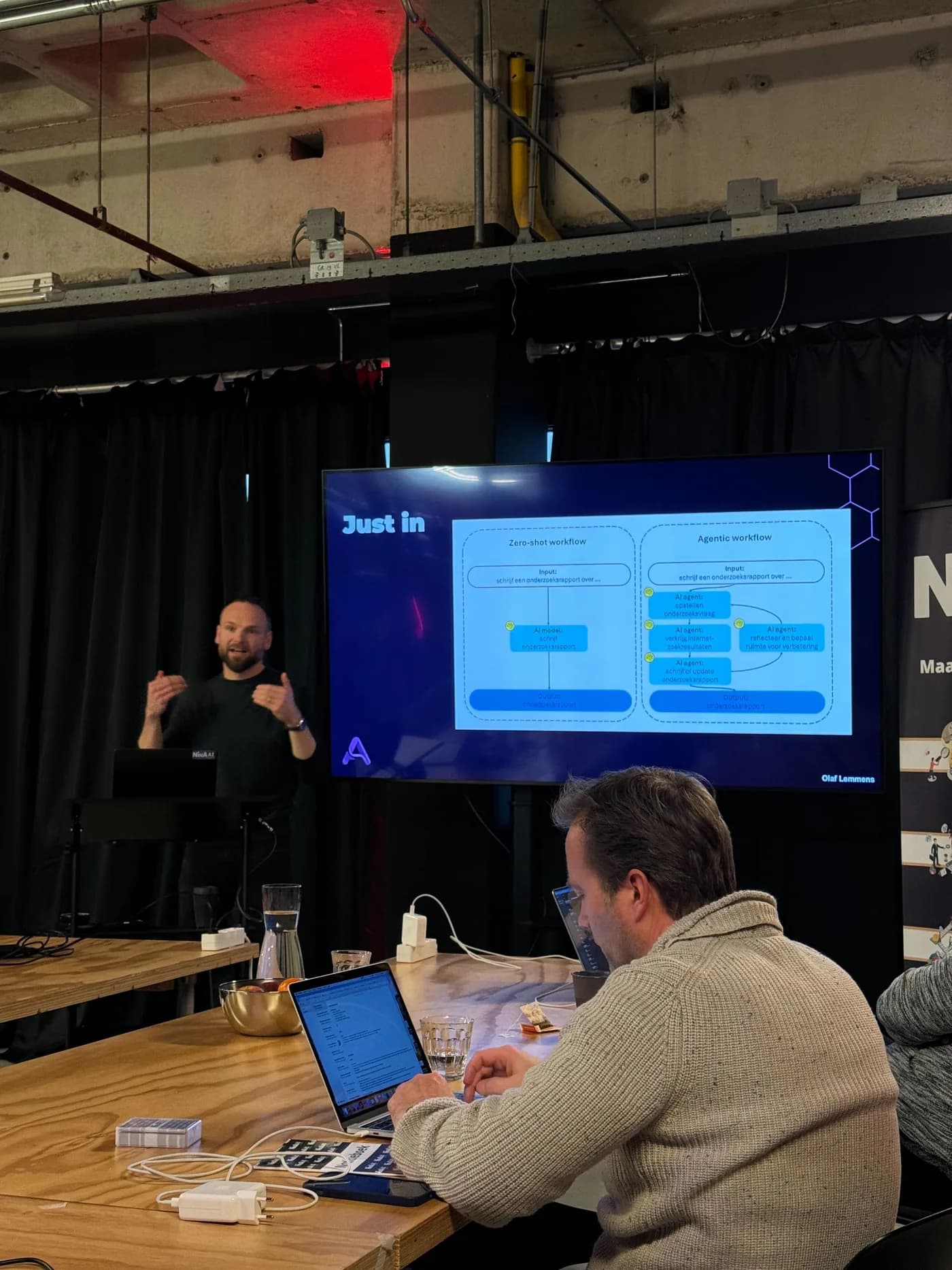
That's how we teach working with Claude Code and with agents: the AI first shows what it plans to do, you approve or adjust, and only then does it get to work.
- 01
Describe the task
You
Describe the task clearly, with context and the result you expect, so Claude can make a good plan.
- 02
Claude shows its plan
Claude
Before anything happens, Claude shows what it intends to do, step by step.
- 03
Approve or adjust
You
Does the plan fit? Then you approve it. If not, you steer it before any work is done.
- 04
Only then does it act
Claude
In small steps, with each step tested. You remain the one who decides.
What comes next
A Skill makes one person faster. A workflow makes the whole process faster.
After the training, your team knows what Claude can do. If you want to know which processes deliver the most once they're truly automated, we calculate that in the AI Quick Scan (€ 6,000). The building happens afterwards in the AI Partnership.
08 / Questions
Frequently asked questions about Claude training.
What does Claude training for businesses cost?
At NinA AI, a hands-on Claude workshop costs € 4,500 per half day, excluding VAT, for ideally 6 to 15 participants. A talk on Claude and AI for a large group costs € 2,450. Preparation and travel within the Netherlands are included. You buy the Claude plans themselves from Anthropic.
What are Claude Projects?
A Project is a fixed workspace in Claude with its own instructions and files. Everything you ask in that Project draws on that knowledge, such as a price list, terms or earlier reports. In Claude Team and Enterprise you share a Project with colleagues, so everyone works from the same basis.
What are Claude Skills?
Skills are folders with instructions, examples and optionally scripts that Claude loads by itself when a task calls for it. Anthropic introduced them in October 2025. There are built-in skills for Excel, Word, PowerPoint and PDF, and you build your own for recurring work, such as a quote in house style. Administrators of Team and Enterprise can enable skills across the organization.
Is Claude safe for company data?
With a business plan (Team or Enterprise) or the API, Anthropic's commercial terms apply: your prompts and files aren't used to train models, unless you sign up for that yourself. On the personal plans Free, Pro and Max, that has been possible since the 2025 terms, unless you turn it off. On top of that, agree which data must not go in.
Do participants need to be able to code for Claude Code?
No. The Claude Code part is designed precisely for advanced users without a programming background. You learn to describe a task well, have Claude make a plan first and test in small steps. Developers get a lot out of it too, but then we set up the session differently.
Can we put a prototype from Claude Code into production?
Sometimes, but not just like that. The gap is in security, error handling, maintenance and integrations. Have a prototype reviewed before any customer data runs through it. We make prototypes production-ready and maintain them within the AI Partnership, because what's built also has to be managed.
Claude, ChatGPT or Copilot: which suits us?
If your organization works entirely in Microsoft 365, Copilot connects most easily. ChatGPT is broadly applicable. In our experience, Claude is strong at writing, analyzing long documents and tasks that take several steps. Many organizations combine them. Choose based on data agreements, administration and how the tool scores on your own tasks.
Does Claude training count towards AI literacy?
Yes. Training on the tool your people actually use is a good measure for the AI literacy that Article 4 of the AI Act asks for. Record who attended and what was covered; according to the European Commission, a certificate isn't mandatory. This is an explanation, not legal advice.
Plan a Claude workshop for your team
In fifteen minutes we know who's in the room, which plans you have and whether Claude Code should be part of it.
01
Intro call
Fifteen minutes, no strings. Where does work get stuck and what do you want to achieve?
02
AI Quick Scan
One day on site. Within a week, a business case and a roadmap.
03
AI Partnership
A dedicated team that builds, trains and shows what it delivers every month.
160+ organizations · Sessions rated 9.3 · Based in Amsterdam