Blog · AI & Development
Vibe Coding - Have You Heard About This Yet?
Olaf Lemmens, Founder NinA AI Agency · April 26, 2025 · 7 min read
Last week I sat down with a potential client. They wanted to develop an internal tool with multiple AI Agents. They already had an idea for the interface.
Could we make a demo?
Traditionally this would cost weeks of development, but I decided we would already create a first impression after the meeting.
Within 90 minutes one of my developers at NinA AI had built a working prototype via Cursor - without writing a single line of code themselves.
Welcome to the era of Vibe Coding - a revolutionary approach that completely transforms the way we build software.
One that can certainly change your business too.
TL;DR
- ▸Vibe Coding has become THE development method in 2025 where (non-)developers primarily write prompts
- ▸25% of YC Winter '25 startups already run on more than 95% AI-generated code, leading to drastically faster time-to-market
- ▸For businesses this means lower development costs, faster innovation, and new business models - but there are also risks
What is Vibe Coding exactly?
The term was introduced by Andrej Karpathy, who described it as "just follow the vibes and leave the rest to the AI".
In essence, Vibe Coding is about programming with prompts instead of syntax.
Take this simple prompt as an example:
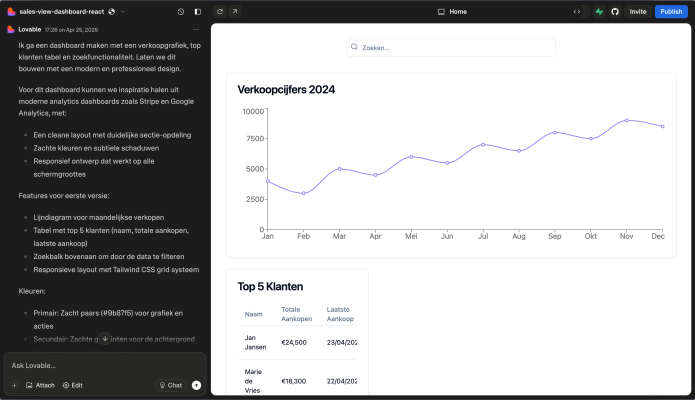
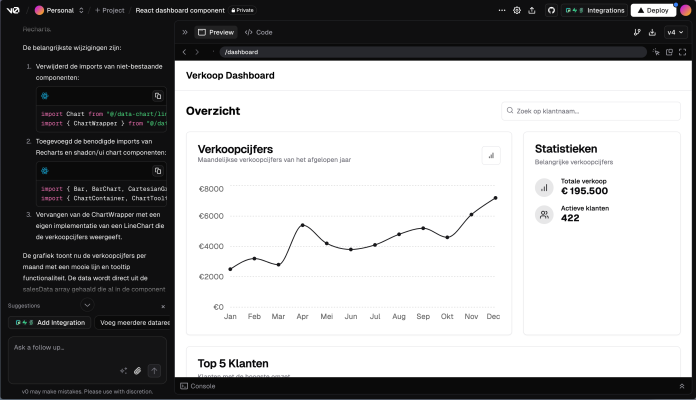
Create a React component that shows a dashboard with:
- A chart displaying sales figures per month
- A table with the top 5 customers
- A search bar to filter through all data
Within seconds the AI generates functioning code that you can then refine and expand.
I tested the above prompt with 2 vibe code tools, Lovable and V0 by Vercel, below you can see the results from the original prompt:
The mindset is revolutionary: you start with working code and refine later, instead of building everything from scratch. The most characteristic aspect?
You accept that you don't fully understand every line of code, but trust tests and AI feedback to ensure quality.
Why agencies and development teams embrace Vibe Coding
The statistics don't lie: 25% of startups from Y Combinator's Winter '25 batch already run on more than 95% AI-generated code.
That's no coincidence.
At NinA AI Agency we see three clear advantages:
- Higher margins: projects that previously took weeks are now completed in days
- Faster turnaround: clients get a first prototype within a few weeks
- Service expansion: we can now offer "prompt engineering" and "vibe-ops" to clients without technical knowledge
But the most interesting part?
Non-programmers can now build MVPs, while engineers can focus on architecture and security instead of writing boilerplate code.
Are those developers still needed? Yes, because experience shows you often end up in an error loop and the question is: where are you going to host the code?
The current Vibe Coding ecosystem
A whole new landscape of tools is emerging that make this revolution possible, a few examples:
Cursor
An AI-powered code editor that converts natural language into code. At NinA we use it for refactoring existing codebases and building new prototypes. It feels like pair-programming with a genius that never sleeps.
Lovable
Goes a step further: it builds complete full-stack applications from a chat conversation. We use it to quickly deliver demos to clients. This way our potential clients already get a good idea of what we're going to build for them.
Firebase Studio
Combines Google's Gemini with Firebase to offer an end-to-end experience: from prompt to live application in minutes. It's our go-to option for mobile projects and web apps that need to scale quickly. Thanks to Gemini 2.5 Pro and Firebase, Google is fully back in our tech stack.
Windsurf, Vo and Bolt are also worth mentioning! And yes, Claude also has a form of vibe coding with Artifacts!
Case study: Doubling revenue with Vibe Coding
The story of Therese Waechter is exemplary of what's possible. This sticker entrepreneur had minimal technical knowledge, but had ChatGPT write Liquid snippets for her Shopify store. After optimizing the user experience, she saw her annual revenue double in 2024.
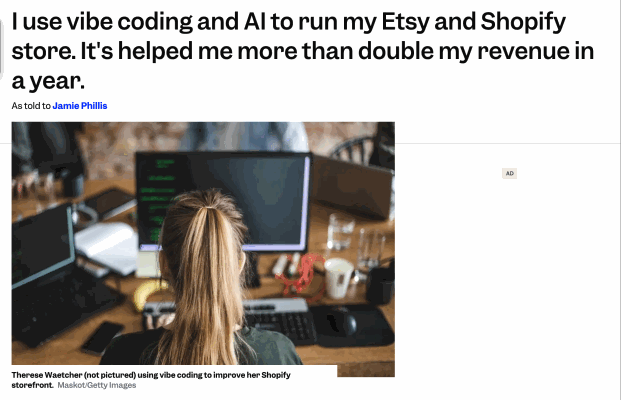
What's so fascinating about this: Therese has no technical background. She "felt" what her online store needed, and let the AI fill in the technical details.
This allowed her to focus on what she was really good at: designing creative stickers and understanding her customers. Technology became an extension of her vision, not an obstacle.
Advantages and pitfalls
Like every revolutionary technology, Vibe Coding has pros and cons:
Advantages
- ▸Super-fast prototyping: what previously took weeks is now done in hours
- ▸Democratization of software: anyone with a good idea can build
- ▸Lower costs: fewer specialists needed for standard tasks
Pitfalls
- ▸Black-box code can hide bugs or security issues
- ▸AI sometimes hallucinates and invents non-existent libraries or functions
- ▸Maintenance remains human work and can become complex if nobody fully understands the code
At NinA we're developing a "vibe coding playbook": a set of standard prompts, best practices for code review, and a risk checklist to avoid these pitfalls.
What does this mean for your business?
The question is not whether, but how you're going to use Vibe Coding. Every organization that uses software (and which one doesn't?) faces a choice: move with this wave or fall behind.
For startups it means you can compete with established players with minimal resources. For enterprise organizations it offers opportunities to drastically shorten innovation cycles.
At NinA AI Agency we see it as our mission to help organizations make this transition. We train teams, build prototypes, and establish long-term AI partnerships. Because ultimately it's not about the technology itself, but about what you can achieve with it for your business.
Conclusion
Vibe Coding is not hype - it's a fundamental shift in how we build software. As someone who's been in tech for years, I've seen many trends come and go. But this is different. This is like the transition from manually writing HTML to WordPress - a democratization that shakes up the entire industry.
The question we must now ask ourselves is not whether we let AI code, but how much control we want to maintain versus how much we delegate. Because in the future we'll probably look back and wonder why we ever wrote every line of code ourselves.
What do you think? Are you already using elements of Vibe Coding in your work? Or do you see obstacles I've missed? I'm curious about your vision on this development.
Until next time,
Olaf Lemmens
P.S. Curious how Vibe Coding can accelerate your development process? Let's connect: tidycal.com/olaf
P.P.S. Want to attend a workshop at our office? The AI Summer School 2025 is coming!