Blog · AI Agents
Why One AI Agent Is Rarely Enough
Olaf Lemmens, Founder NinA AI Agency · January 23, 2026 · 6 min read
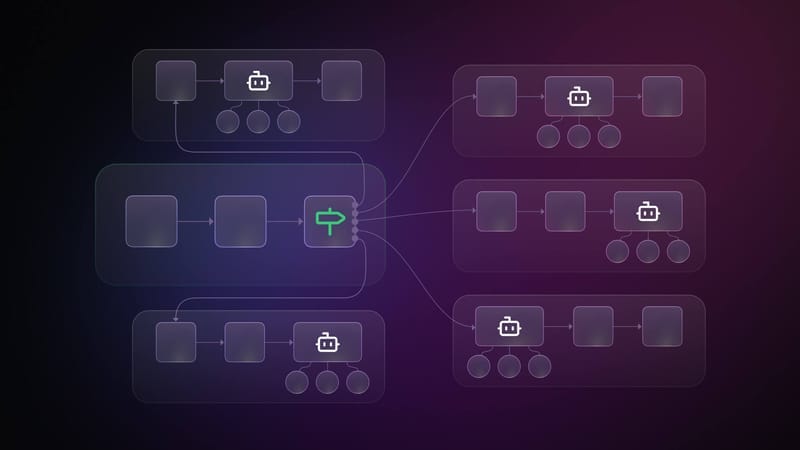
Deploying one AI agent to automate all your processes sounds tempting. One smart model that answers customer questions, searches documents, analyzes data, and sends emails. But as soon as you try this, you hit the limits. AI works better as a team.
TL;DR:
- •One AI agent for everything sounds good, but gets stuck quickly
- •Multi-agent systems are scalable, reliable, and specialized
- •Agents communicate via messages, just like people in a team
- •You can build this yourself in tools like n8n
What is a multi-agent system?
A multi-agent system is exactly what it sounds like: multiple AI agents working together on a task.
Instead of one generalist doing everything, you have specialists. One agent handles emails, another processes documents, a third talks to your CRM. They work together like a team of colleagues would.
This makes the system not only smarter, but also more manageable.

Single-agent vs. multi-agent: the difference
A single-agent system has one agent that does everything itself. Simple, but limited. It quickly becomes overloaded and is hard to scale.
A multi-agent system divides the work. Each agent has its own role. The system becomes more robust, faster, and easier to expand.
How does a multi-agent system work?
A practical example: you receive an email from a customer.
- 1.Intake Agent – Reads the email and determines what kind of question it is.
- 2.Router Agent – Routes the question to the right specialist.
- 3.Support Agent – Answers customer questions, searches the knowledge base.
- 4.Invoice Agent – Handles invoice-related questions.
- 5.Output Agent – Writes the answer and sends it.
Each step is handled by a different agent. The workflow is therefore clear, error-resistant, and easy to adjust.
How do agents talk to each other?
Agents communicate via messages, just like people in a Slack or Teams channel.
There are two common forms:
- •Central (Orchestrator) – One director agent distributes tasks and collects results.
- •Decentralized (Peer-to-peer) – Agents talk to each other directly without a central coordinator.
Which one you choose depends on your use case. Many customer-facing workflows work well with an orchestrator. More complex systems can benefit from peer-to-peer.
Build it yourself in n8n
You don't need to code to do this. With tools like n8n, you can visually build and connect agents. You create nodes, connect them with arrows, and define triggers.
Want to get started? Check out our n8n workshops or AI Agents.
Benefits of multi-agent systems
🎯 Specialization
Each agent is an expert at one task.
📈 Scalability
Add agents without rewriting the system.
🛡️ Robustness
If one agent fails, the rest keeps running.
🔧 Maintainability
Easier to test and debug.
The downside: complexity
More agents = more moving parts. You need to think about:
- •Communication – How do agents exchange information?
- •Orchestration – Who coordinates?
- •Error handling – What if something goes wrong?
- •Monitoring – How do you know if it's working?
That's why it's smart to start small. Start with two or three agents. Expand when you know what works.
Conclusion
One AI agent is often not enough. Especially not when your tasks become complex or you want to scale.
Multi-agent systems offer a flexible, robust way to make AI really work for your business. They are modular, testable, and expandable.
Start small. Build smart. And let your agents work together.
Want to discuss this? Or need help setting up your first multi-agent workflow? Schedule an introduction via the button below.
Until next time,
Olaf Lemmens
Founder @ NinA AI Agency