Blog · AI Models
Chinese AI Models Are Good, REALLY Good
Olaf Lemmens, Founder NinA AI Agency · November 15, 2025 · 5 min read
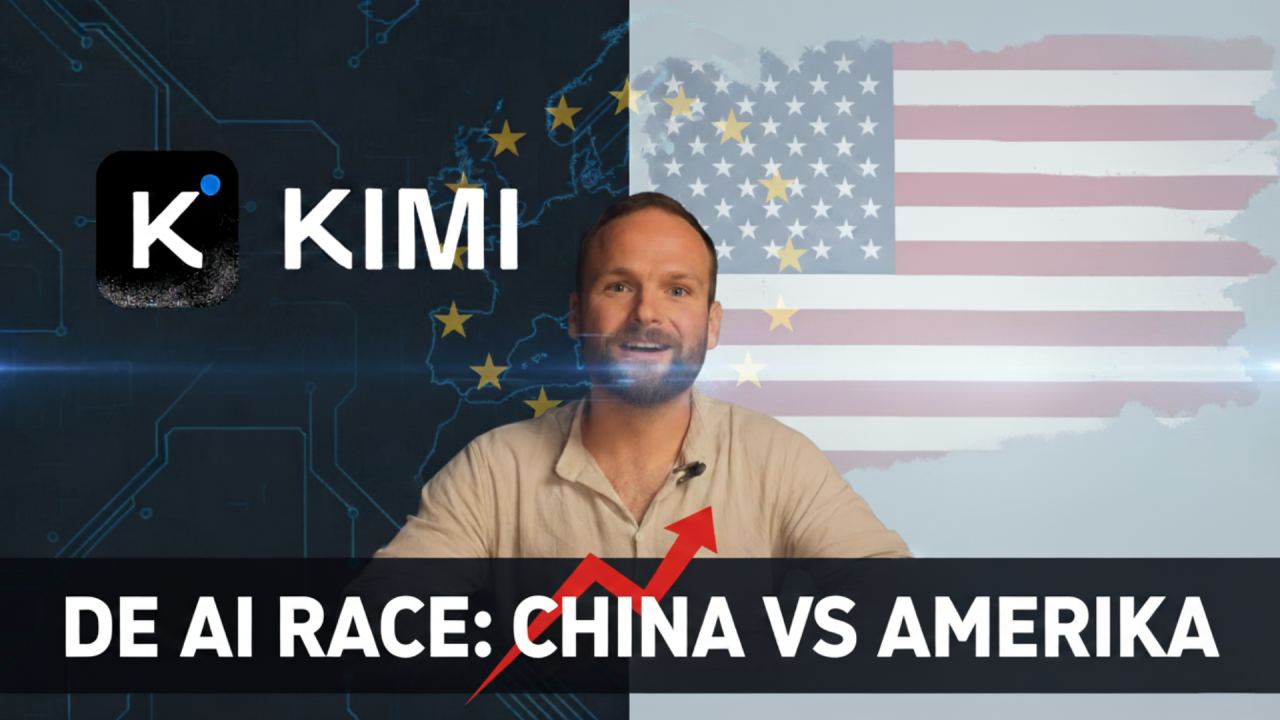
Kimi K2 Thinking has launched. And that's more important news than it might seem at first glance.
Not because it's yet another "better model". But because it shows exactly where AI is heading: from smart assistants to fully autonomous workers.
Moreover, after DeepSeek earlier this year, it's another Chinese model delivering strong performance at lower prices than American models.
Kimi executes tasks across hundreds of steps, uses tools, searches for information itself, and builds working software without you having to do anything.
The model is open. Self-hostable. No closed API. No lock-in. This makes it incredibly secure, as all data stays with you.
That said, for most people this isn't feasible. (Businesses can though, we're happy to help!!)
So then the question becomes, would you rather have a subscription with an American or a Chinese model.
Most still choose the former. And that makes sense.
But let's dive into this latest model anyway!
TL;DR:
- •Kimi K2 executes up to 300 steps without intervention
- •Open source and self-hostable: finally control over your own AI infrastructure
- •My advice; what do I recommend?
What makes Kimi K2 special
Kimi K2 Thinking is not a chatty chatbot. It's a thinking-agent.
The model can plan 200 to 300 steps ahead, use tools (from browser to Python), and complete complex tasks autonomously.
It solves PhD-level mathematics. It builds front-end apps in React from a single prompt. And it does all of this without you having to intervene.
That last part is key. Because many companies still think in "chatbots". But Kimi shows: AI is no longer a conversation partner. It's a coworker.
Why this goes beyond benchmarks
Kimi scores high on everything that matters: HLE, SWE-Bench, BrowseComp.
But that's not what I care about.
What's more important: you don't have to rent this model through an expensive API. You can run it on your own infrastructure. Fine-tune it. Manage it yourself.
For teams that want to build their own AI workflows (think search agents, repo fixers, internal copilots) this is a gamechanger.
Not just faster. But especially: controllable and scalable.
What you can do with this in your organization
Imagine: you work with lots of internal documents. Procedures. Reports. Or codebases that constantly change.
Then you don't want to depend on a prompt in ChatGPT.
You want an agent that searches, reasons, checks, searches again, reasons again – until the problem is solved.
That's what Kimi does. And it's open. So you can make it do exactly what you want.
The real shift: from prompt to process
Most AI projects fail at one point: nobody has time to keep prompting every time.
What Kimi enables is thinking in processes:
- Receive input
- Call tools
- Validate results
- Execute actions
- Process feedback
- Continue until done
No loose prompts. No half answers. No babysitting.
Just: an AI that does its job.
My advice
It's a great update, but be aware that it remains a Chinese model. The question is whether you always want to trust that. Be careful with what you share, just like with other language models!
Definitely test it out for yourself and play with it. For the general tasks you might already do with ChatGPT, you won't notice the difference quickly. The difference only comes with truly complex tasks. So you don't need to switch right away.
If you want to think about using this model within workflow automation, we should definitely connect. Within the process optimizations we build for our clients, a self-hosted version of Kimi K2 is really mega interesting. Top of the line and secure.
What do you think of Kimi K2?
I'd love to hear what you think. Let me know.
Until next time,
Olaf Lemmens
Founder | NinA AI Agency
P.S. We help organizations move from loose AI tests to concrete, scalable implementations. Build yourself, run yourself. Curious? www.nina-ai.nl