Blog · AI & Business
"Hire an AI before you hire a human" - Shopify CEO sets the new standard
Olaf Lemmens, Founder NinA AI Agency · April 12, 2025 · 8 min read
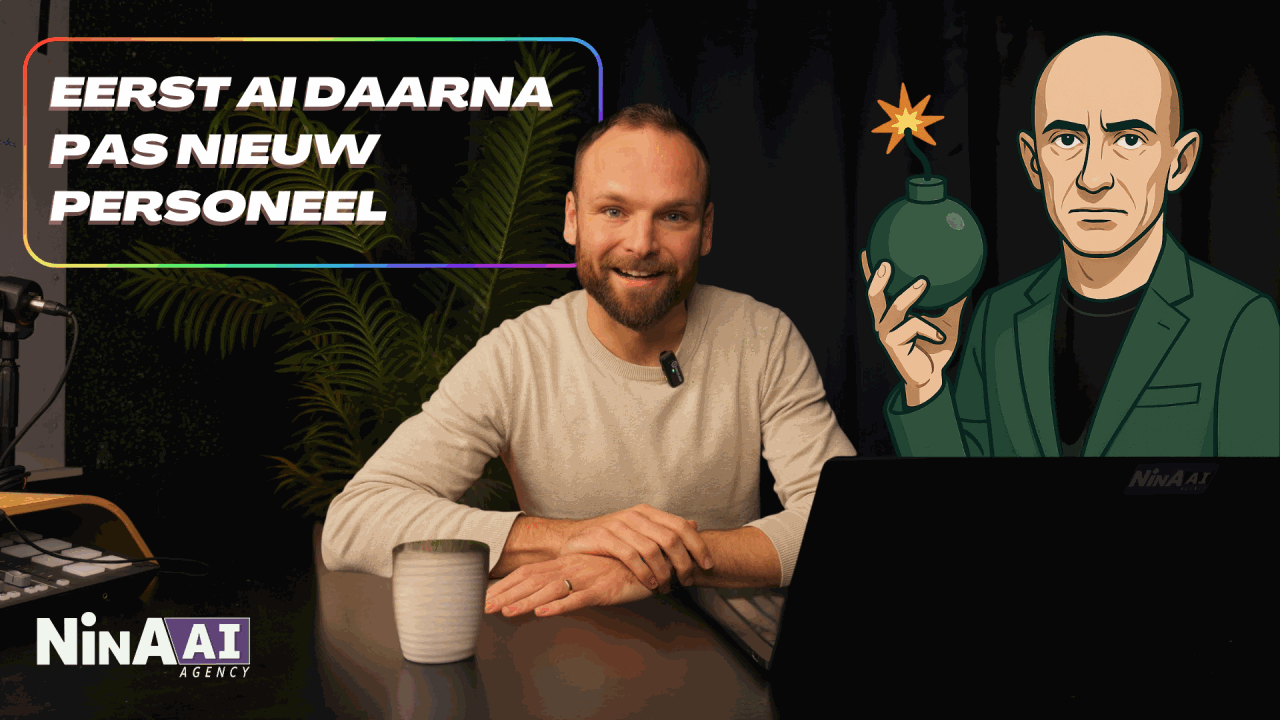
I'll be honest, I do spend time on X. Mainly to follow people in AI though. There I saw a leaked internal memo from Shopify CEO Tobias Lütke. A memo that went viral in these circles, and not without reason.
The document sets a radically new standard: "Using AI effectively is now a fundamental expectation of everyone at Shopify." Not just developers or analysts - everyone.
As I scrolled through the memo in my office in Amsterdam, I felt a strange mix of confirmation and urgency.
What I've been telling my clients for months is now firmly confirmed by the CEO of a company with $8.8 billion in revenue: AI is no longer optional, it's a necessity.
The memo ends with a warning that lingered in my head: "Standing still is failing in slow motion. If you're not climbing, you're sliding backwards."
TL;DR
- ▸Shopify CEO Lütke makes AI usage mandatory for all employees and introduces the radical principle: "Hire an AI before you hire a human"
- ▸Teams must prove why they CAN'T use AI before getting additional people or resources
- ▸AI proficiency is now measured in performance reviews, just like other crucial skills
The memo: a new era for organizations
What makes this memo so special? Lütke transforms AI from an experimental project into a fundamental business value.
The key points:
- 1. AI proficiency is now mandatory. Effective use of AI is no longer optional at Shopify - it's a basic expectation for all employees, regardless of their role.
- 2. AI in the prototype phase. "The prototype phase of every GSD project must be dominated by AI exploration."
- 3. AI usage in performance reviews. "We will add AI usage questions to our performance and peer review questionnaires."
- 4. Knowledge sharing is essential. "Learning is self-directed, but share what you've learned." Shopify provides tools like chat.shopify.io, proxy, Copilot, Cursor and Claude code.
- 5. Burden of proof is reversed. "Before asking for more people and resources, teams must demonstrate why they cannot achieve what they want with AI."
10 key insights from the memo
A tech analyst who reviewed the memo shared ten crucial insights that perfectly summarize its impact:
- 1. A subtle but enormous reframing: "Hire an AI before you hire a human." This is a paradigm shift in workforce planning.
- 2. AI has become a baseline expectation. Hiring filters will likely favor AI-proficient candidates.
- 3. AI agents are now treated as team members, not tools. This fundamentally changes how we think about work.
- 4. Prompting is now a core skill. The best performers will be the best prompters.
- 5. AI usage is now measured. This opens new business opportunities for tools that can measure AI usage.
- 6. AI-first prototyping is the new standard. Delivery speed will likely increase 10x.
- 7. Organizational structures blur. Workforce planning now includes bots, not just people.
- 8. AI literacy is the new coding literacy. Prompting, contextualizing or evaluating AI output becomes mandatory.
- 9. AI is now a core layer in the software stack. No plugin, no add-on. AI sits alongside infrastructure, backend, frontend and design.
- 10. More impact per person. Shopify leads the way, but this will likely hit every major enterprise in the next 12-24 months.
It's not just Shopify
Shopify is not alone. Other leading CEOs are taking similar steps:
- ▸Jon Moeller (P&G) describes AI as "a force multiplier for growth and productivity" already deployed for quality control, product development and personalized marketing.
- ▸Jane Fraser (Citigroup) has made AI a central pillar of the bank's $12 billion modernization strategy.
- ▸Chip Bergh (Levi Strauss) uses AI to sharpen demand forecasting, optimize inventory and make the supply chain more agile.
What these leaders understand is that AI is much more than tools and apps. It's not a sidecar of business strategy. It IS the business strategy.
Implications for your organization
At NinA AI Agency we already see this shift among forward-thinking clients.
Just last week I sat with a client in the financial sector who had an entire team performing manual checks.
With AI they can automate that process by 20 to 80%, allowing their people to focus on more complex tasks where human insight is irreplaceable.
What can we learn from Lütke's approach?
- 1. Mandate usage, don't just encourage exploration. Make it clear that using AI is not optional. Integrate it into work processes and expectations.
- 2. Reverse the burden of proof. Don't ask why people want to use AI, but why they would NOT use it.
- 3. Make AI part of your workforce planning. Think of AI agents as team members, not tools.
- 4. Integrate AI skills into performance reviews. What you measure, improves.
- 5. Invest in AI knowledge sharing. Create platforms and moments for teams to share their AI insights and successes.
The "self-driving" enterprise
We are rapidly approaching an era where leading companies will function as autonomous enterprises - data-driven, AI-orchestrated, highly automated and continuously learning.
This may sound like the future, but companies like Shopify are showing it's already reality.
They're creating organizations where:
- ▸Teams deploy autonomous AI agents before asking for more people
- ▸Prototypes are developed in a fraction of the time
- ▸Routine tasks are automated, allowing people to focus on strategy and creativity
- ▸AI doesn't just support, but actively shapes decision-making
A client of ours in e-commerce recently transformed their customer service with AI. Instead of hiring new employees to keep up with growing demand, they implemented AI agents that can handle 70% of routine inquiries.
Their human team members now only handle the more complex cases, leading to higher customer satisfaction and lower costs.
Conclusion
What Shopify has shown is that the road to this AI-driven future isn't paved with expensive platforms or massive personnel changes - it's built by creating a work culture where AI is part of every project, every role and every decision.
Lütke's memo is more than an internal guideline. It's a blueprint for how modern organizations must operate to remain competitive. The central insight? "Hire an AI before you hire a human."
This doesn't mean people become less important - quite the opposite.
It means people can focus on what they do best: creative thinking, complex problem solving and strategic decision making. AI takes over the routine work, so human talent can shine.
The reality is clear: organizations that treat AI as a way of life will thrive. Those that relegate it to the IT department or treat it as an experimental project will fall behind.
What's your vision on this? Is your organization ready to treat AI as a fundamental business value? Or is AI still in its infancy at your company? And perhaps more importantly: is your organization willing to embrace the principle "hire an AI before you hire a human"?
Until next time!
Olaf Lemmens
P.S. At NinA AI Agency we help organizations effectively integrate AI into their work processes and make this cultural shift. Want to know how? Let's connect: tidycal.com/olaf/kennismaking-30-minuten-olaf