Blog · AI & Process Optimization
Process Optimization Is Hot and It's Called: AI
Olaf Lemmens, Founder NinA AI Agency · September 28, 2025 · 7 min read
Last week a director called me asking: "Olaf, we want AI agents. What will they cost?"
My answer? "That depends. What does your order process look like right now?"
"Well, first we get an email, then we manually enter it in Excel, then we create a quote in Word, convert it to PDF..."
I interrupted him: "Stop. You don't need an AI agent. You need process optimization."
And that's exactly where we are now. Everyone is screaming for AI agents, but forgetting the basics. Over the past months it became increasingly clear to me. We use AI, but it's not the most important piece we work with daily. That's the process itself.
The question is: are you ready for it?
TL;DR:
- •Voice agents confirm hundreds of appointments per day and reduce no-shows by 40% — more effective than SMS/WhatsApp
- •Procurement processes automated from supplier sourcing to contract approval within hours instead of weeks
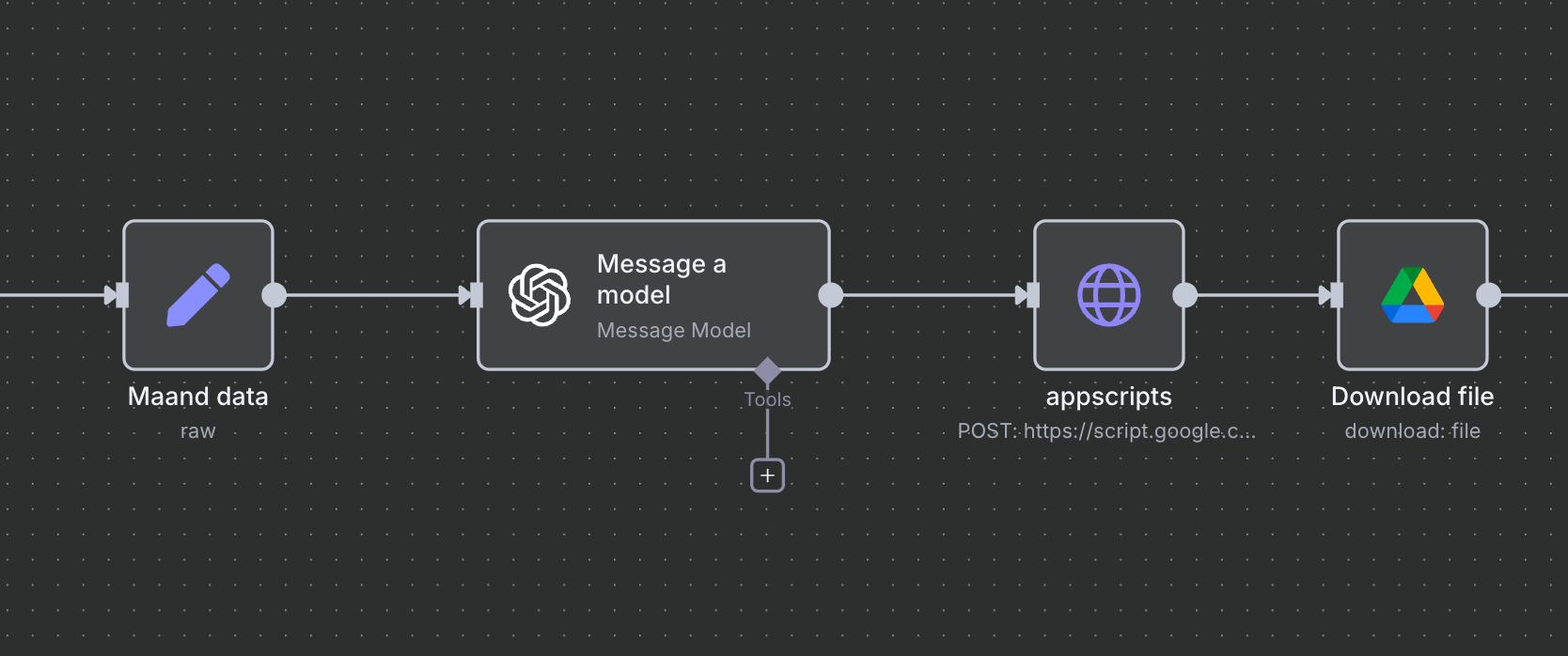
- •N8N workflows with integrated app scripts transform marketing, sales and HR processes without external tools
AI follows your process, not the other way around
Here's what changed in the past 90 days.
OpenAI launched GPT-5 Codex: a variant that handles long, autonomous coding tasks, but only useful if you have developers in-house.
Anthropic gave Claude better reasoning capabilities.
And we at NinA AI Agency implemented N8N at more than 10 companies as their workflow automation platform, fully hosted in the Netherlands.
But the real breakthrough? AI that actually does useful work in every department of your company.
The result? For the first time we can build workflows that don't just advise, but also execute directly — from customer conversations to supplier negotiations, from lead qualification to recruitment.
But (and this is crucial) they still follow your existing process.
"If your process sucks, you get automated suck."
At NinA AI Agency we see this weekly. Clients come in asking: "Build us an AI agent that does X." Then it turns out their process has 17 steps, 11 of which are manual repair work from earlier mistakes.
First rule of AI implementation: optimize the process, then automate.
Process optimization per department: what actually works
🎯 Sales: From lead to deal in record time
Traditional sales process: Lead comes in → manual qualification → CRM entry → follow-up planning → demo scheduling → proposal creation → contract negotiation.
Optimized: The AI Workflow does first qualification within 2 minutes. AI scores leads on fit and budget. Qualified leads get demos auto-booked in the salesperson's calendar. Proposals generated via app script based on qualification answers.
📣 Marketing: Content and campaigns on autopilot
Traditional: Manual content planning → writing individual posts → social media scheduling → performance tracking → creating reports.
Optimized: AI analyzes trending topics and competitor content. N8N workflow generates content calendar, writes posts, schedules publication, and monitors performance. App script generates weekly performance reports with insights.
📦 Procurement: From request to contract in hours
Traditional procurement process: Request → find supplier → request quotes → compare → negotiate → contract → approval → order.
Optimized: AI analyzes procurement needs and automatically finds suitable suppliers. Voice agents call for initial price information. AI compares quotes on price, quality and delivery terms. App script generates contract proposals and approval workflows.
👥 HR: From vacancy to contract in weeks, not months
Traditional: Write vacancy → post → screen CVs → phone screening → schedule interviews → check references → make offer.
Optimized: AI writes vacancies based on role analysis. Voice agents conduct first screenings with candidates. AI evaluates CVs and interview answers. App script generates standardized contracts and onboarding documents.
The decision guide you need
🎙️ Voice Agents
For all departments where you regularly make calls. Sales (lead qualification), Marketing (customer research), Procurement (supplier contact), HR (candidate screening). Scale is unlimited and effectiveness higher than email or forms.
📊 AI for data analysis
For pattern recognition in all processes. Sales forecasting, marketing performance, supplier evaluation, HR analytics. Here we combine different LLMs depending on the use case.
⚙️ N8N + App Scripts
For end-to-end process automation. From lead capture to contract signing, from content planning to performance reporting, from procurement needs to supplier management.
The difference: Where other platforms force you to jump between tools, we do everything within one workflow. Voice agent collects data, AI processes information, app script generates outputs — everything is production-ready without manual intermediate steps.
Voice agents: why calling still works best
Let's be honest: nobody's waiting for another chatbot. But voice agents for appointment confirmations? Game-changer.
Traditional teams send SMS or WhatsApp messages for appointment confirmations. Result: 20-30% no-show rate because people ignore or forget messages.
Our voice agents call clients personally. Within hours we can confirm hundreds of appointments. And here's the kicker: calling still works best. No-show rates drop by 40% compared to text messages.
Why voice agents work where SMS/WhatsApp fail:
- 1Human reflex: People pick up the phone. They ignore messages.
- 2Direct interaction: "You have an appointment tomorrow at 2 PM. Does that still work?" → "No, can we do 4 PM?" → "One moment, let me check... yes that works, I'll reschedule you."
- 3Scale: A voice agent can make 200 appointment confirmations per day. Your team can maybe do 40.
- 4Cost: A full-time assistant for appointment confirmations costs €30,000+ per year. Voice agents cost a fraction of that.
Case study: A client had a 25% no-show rate. Their assistant manually called 30-40 patients per day for confirmations — 3 hours of work.
Our voice agent now calls 200+ patients per day, confirms appointments, schedules changes, and sends summaries to their practice software. No-show rate: 12%. Time saved: 3 hours per day.
Dutch hosting
With N8N hosted in the Netherlands and voice agents on Dutch servers, all business data stays on European soil. No American clouds, full GDPR compliance, and predictable costs.
Process optimization in 30-60-90 days
📅 30 days — Quick wins per department
- • Sales: Voice agents for lead follow-up
- • Marketing: Automated content planning
- • Procurement: Supplier sourcing automation
- • HR: CV screening and initial candidate contact
- • Customer Service: Voice agents for appointment confirmations
🔗 60 days — Cross-functional workflows
Integrate departments. Sales generates leads → Marketing nurtures → Sales closes → Procurement orders → HR onboards new client teams. One integrated workflow from lead to delivery.
🧠 90 days — Advanced intelligence
AI learns from all processes. Predicts which leads will close, which content converts, which suppliers will delay, which candidates will stay. Proactive optimization instead of reactive fixes.
My expectation for 2026
The hype around "AI agents" will subside. The focus shifts to "process intelligence" — AI that understands and improves your entire business operation.
Voice agents become mainstream for all customer-facing processes. Workflow automation connects all departments. Companies that start now with phased implementation will walk into 2026 with competitive advantage in every business unit.
"AI isn't a magic bullet. It's a multiplier. Multiply bad processes with AI and you get fast, scalable chaos."
Multiply optimized processes with AI and you get competitive advantage in sales, marketing, procurement and HR.
My question to you: which department in your company spends the most time on repetitive tasks?
That's where your process optimization starts.
No fancy 6-month strategy sessions.
No 200-slide consulting presentations.
Just: identify the problem per department, optimize the workflow, implement AI, measure results. It's that simple. And that's how complex most companies make it.