Blog · AI Startup
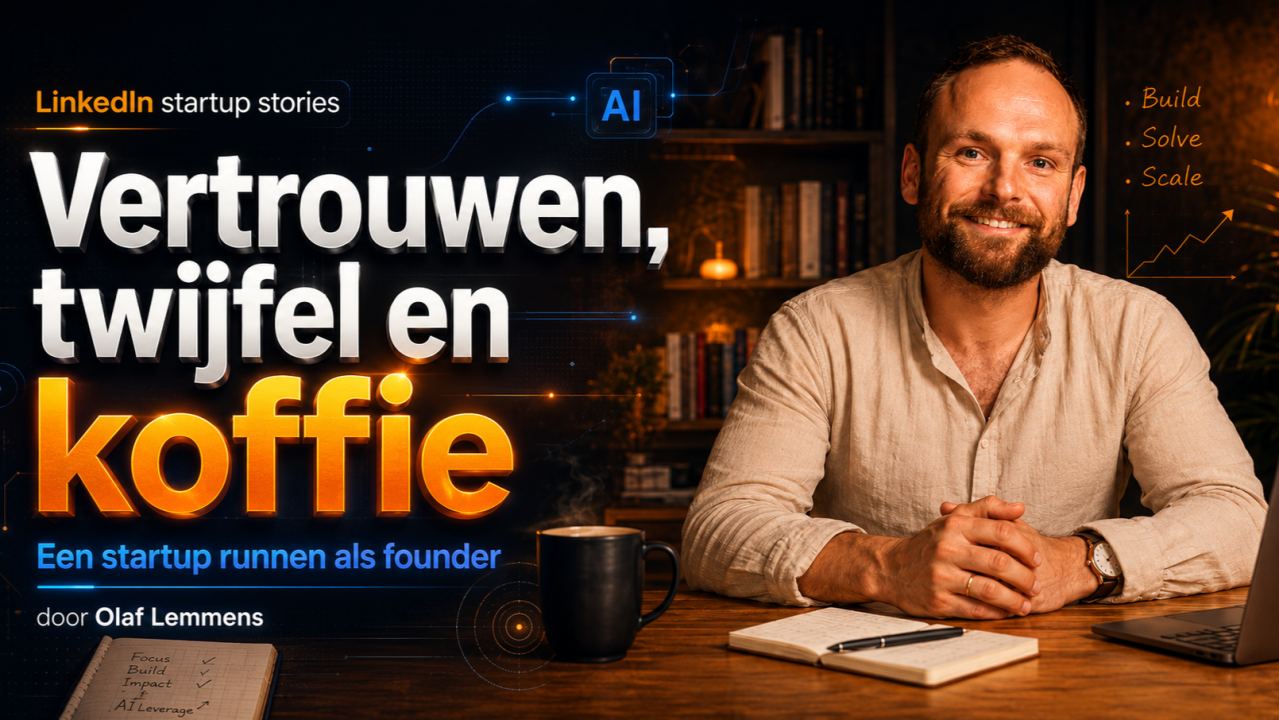
Running a startup on trust, doubt and coffee
Olaf Lemmens, Founder NinA AI Agency · May 16, 2026 · 6 min read
Saturday morning.
The week is over, but my head hasn't fully stopped yet.
That often starts on Friday. One more conversation, one more coffee moment, one more meeting where the loose ends of the week suddenly land on the table. Not as a tidy agenda. More as a pile of thoughts that have been rattling around in your head for days.
This week I sat down with my head of development and project manager.
No big strategy presentation. No quarterly plan. No fancy deck.
Just coffee. An open conversation. About projects. About quality. About demos. About AI agents. About preparation. About bringing clients along. About developers who sometimes get too deep into the tech. About project management that's increasingly becoming product ownership. About when something is good enough to show.
And especially about myself.
Because somewhere in a conversation like that, you notice again as a founder how double everything feels.
Optimism
On the one hand, I'm incredibly optimistic.
I see what we're building. I see how fast AI is developing. I see how much value is created when you don't just deliver something to a client, but actually think along. Not just "here's the automation". But: "we made these choices because they fit your process, your client, your way of working better."
That's where I think an AI agency makes the difference.
Not in clicking tools together.
Not in shouting that everything can be faster and cheaper.
But in the choices underneath.
Which language model do you use? Why that one? Have you tested alternatives? Is speed more important than quality? Can a conversation be slightly more expensive if the output is much better? Which prompt structure are you using? What assumptions does it contain? Which words are too vague for an AI system? Where are the guardrails? What do you show a client, and what not yet?
Those aren't details.
That's the work.
And that's exactly where my optimism sits.
Because the more AI becomes available to everyone, the more important craftsmanship becomes. Soon, anyone can build something. But not everyone builds something that's reliable, explainable and usable in a real organisation.
I believe in that wholeheartedly.
Uncertainty
But on the other hand, there's also uncertainty.
Not the paralysing kind. More the kind that keeps you sharp.
I doubt continuously.
Not about AI. Not about the market. Not about the potential.
But about ourselves.
Are we sharp enough? Do we test enough? Do we bring clients along early enough? Are we showing too much tech? Or too little? Are we giving developers enough room for deep work? Are we giving them enough structure to work professionally with clients? Am I clear enough about what I expect? Or am I shielding people too much?
That last one might be the hardest.
A startup is sometimes a strange play.
Outwardly you tell the story of growth, opportunity and momentum.
And that story is true.
But internally you also know: growth is never only beautiful.
A record-revenue month can also be a record-cost month. A team can be talented and still need to learn how to document, prepare, hand over and take ownership. A project can go technically well and still feel messy because the demo was prepared too late. A client can be enthusiastic while in your head you're thinking: we need to do this tighter next time.
That's the strange part.
Optimism and uncertainty don't contradict each other.
They need each other.
Without optimism you build nothing. You just keep analysing, doubting, postponing.
But without uncertainty you start believing your own story too easily. "We're doing great" slowly becomes an excuse to be less critical.
I think good AI companies have to learn to live exactly between those two.
With enough trust to keep building forward.
And enough doubt to not get sloppy.
Quality
During that coffee we kept coming back to one point: quality has to become more visible.
Not just at the end of a project.
But while building.
A prompt shouldn't be one long blob of text that happens to work. It needs to be structured. Understandable. Tested. Critically reviewed. And based on our own 8-step prompt framework.
A demo shouldn't just show that something works. A demo should show why certain choices were made.
An AI model choice shouldn't be: "this is the one I always use."
It should be: "we tested this, these were the differences, and that's why we recommend this."
That might sound simple.
But in practice this is exactly where many AI projects succeed or fail.
Not on the tool.
On the discipline around it.
The preparation. The second pair of eyes. The internal demo. The question of whether someone else can explain your choice. The composure to not flood a client with a hundred options, but to present three good ones. The courage to say: this isn't ready for live testing yet. Or: this is early enough to gather feedback on together.
That's growing up as a company.
Growing up
That's exactly where we are.
We build. We learn. We tighten things. We make mistakes. We improve processes. We look for balance between speed and quality. Between freedom and structure. Between giving trust and keeping control.
I notice that as a founder I sometimes long for grip.
I want to know what everyone is working on. I want demos to be well prepared. I want clients to feel that we're on top of the content. I want the team to be proud of what they make. I want us to be advisors, not just executors.
But I also know that you don't get grip by sitting on top of everything.
Grip comes from rhythm.
From standards.
From teaching people what good work looks like.
From not just asking: "is it done?"
But also: "can you explain why you built it this way?"
That might be the most important question I want to ask more often. Because if you can't explain your choice, the choice probably isn't sharp enough. And if you can explain it, something beautiful grows.
Then technology suddenly becomes advice. Then a developer becomes an expert. Then a project manager becomes a product owner. Then a client isn't a spectator but part of the build.
And then AI isn't something magical you just have to trust. But something you understand, test and improve together.
That's the direction I want to go.
I'm often uncertain. About timing. About team growth. About cashflow. About expectations. About how fast you should professionalise without losing the energy of a startup.
But I'm also optimistic.
Because I see the bar can rise.
Because I see clients need more than just build capacity.
Because I see AI only becomes truly valuable when you organise responsibility around it. And because I believe more and more that uncertainty isn't a weakness.
Maybe that's how you run a startup.
Not with blind trust.
Not with constant doubt.
But with coffee on the table, good people around you, and the willingness to honestly look again and again at what could be better.
Until next time,
Olaf Lemmens
Founder NinA AI Agency
P.S. Curious how we approach AI projects with that balance between trust and doubt? Plan an intro call. Or visit www.nina-ai.nl