Blog · AI & Strategy
When Should You Use AI? And When Should You Not?
Daan van Drunen, AI Content Specialist NinA AI Agency · April 1, 2026 · 8 min read

There's one question I get more than any other: "Olaf, where should I actually use AI and where not?"
Honestly? Most lists about this are either too vague or too technical. But Ethan Mollick, professor at Wharton, wrote something I thought was really good. Practical. Honest. Without hype.
He listed 15 situations where AI moves you forward. And 5 where you're better off leaving it. In this newsletter I'll walk you through them, including my own experience.
TL;DR
- ▸15 concrete situations where AI actually helps you
- ▸5 moments when you should avoid AI
- ▸Knowing when to deploy AI is a skill in itself
These are the 15 situations where AI truly moves you forward:
1. Work that demands quantity. Think brainstorming. The quality of your best idea depends on how many ideas you generate. Most people stop after five attempts because they get tired. AI can deliver hundreds without repeating. You pick the gems.
2. Work where you're the expert. If you have enough knowledge to quickly assess whether the output is correct, AI is an enormous accelerator. Even with complex work. The point is: you must be the quality control. Without expertise, you're blind to the errors.
3. Creating summaries. AI is strong at summarizing long documents. But be careful: only deploy it when the margin of error is low and you're not responsible for every detail. AI summarizes well but doesn't fact-check.
4. Translating between audiences. You've written a policy memo and now need to convert it into ten different training documents for different teams. AI is excellent at this. Increasing or decreasing complexity to match your audience's level? It does that lightning-fast.
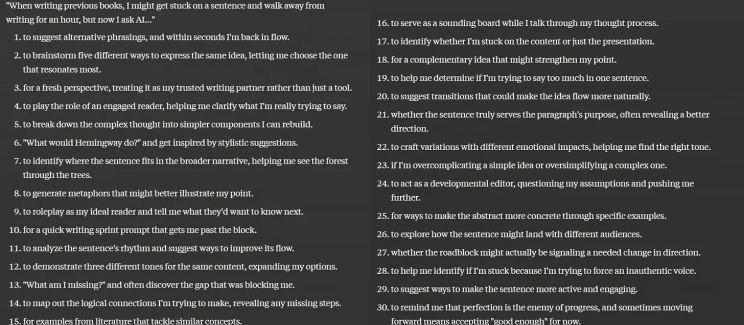
5. Work that keeps you moving. Small blockages can stall you for hours. You used to get stuck on one sentence and lose an hour. Now you ask AI for thirty variants of that one sentence.
6. When AI is better than the best human you can reach. Not everyone has access to a top lawyer, native speaker, or data specialist. If AI performs better than your alternatives on that specific point and the consequences of an error are limited, it's a logical choice.
7. When you're missing context or details. You can use AI as a reading buddy. You read an article, understand the big picture, but want more background information. AI lets you ask infinitely many questions without anyone sighing.
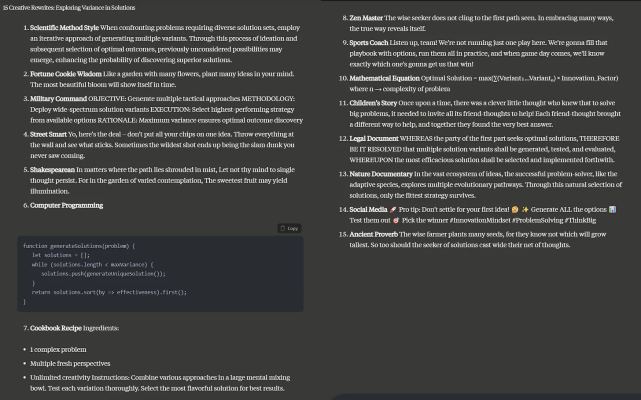
8. When you need variation. Ask for fifteen radically different rewrites of the same text. You're the curator. You choose the best. It delivers surprising perspectives you wouldn't have thought of yourself.
9. Coding. This one speaks for itself: AI helps with many forms of programming. Whether you're a beginner or a senior developer, the productivity gains are measurable.
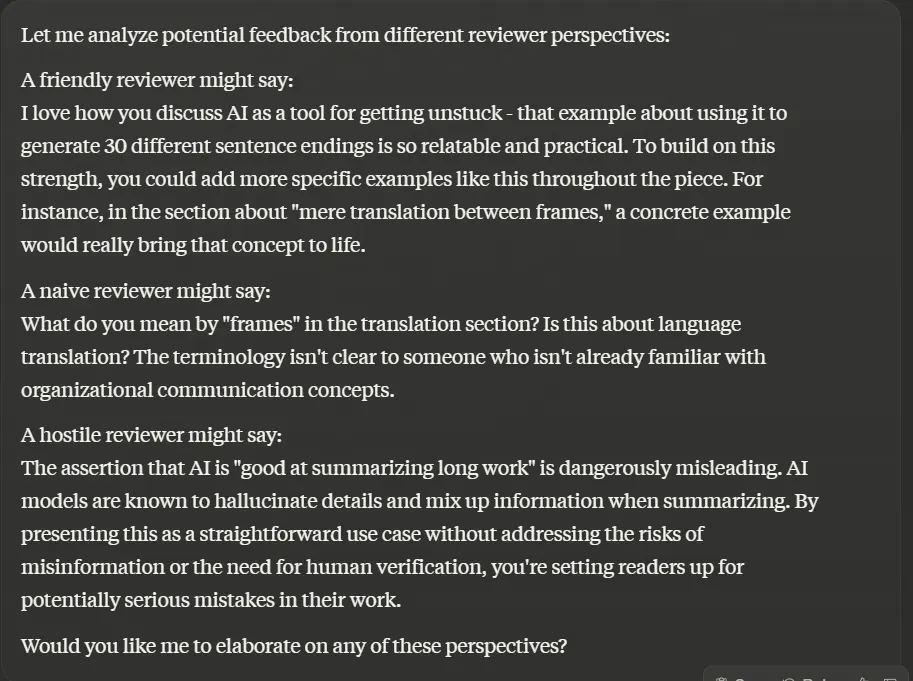
10. Getting pushback. Want to know how a critical recipient, an enthusiastic fan, or a complete novice reacts to your proposal? Let AI simulate those perspectives. No replacement for real feedback, but a strong first check.
11. Entrepreneurship. As an entrepreneur, you need to know a bit of everything. Financial plan, pitch deck, market research, legal basics. The choice is often not "AI or an expert" but "AI or nothing at all." Then a good AI partner is worth its weight in gold.
12. Simulating specific perspectives. Similar to point 10, but broader. Fictional personas, target group profiles, stakeholders. A simulated first reaction from a specific perspective can sharpen your strategy.
13. Ritual work. We all know it: reports nobody reads, forms that haven't served a purpose for years. In an ideal world, you abolish them. In the real world, you let AI do the heavy lifting. But be honest: when it does matter (think performance reviews), human input is indispensable. Human in the loop is crucial in this kind of automation. We're happy to help you with this!
14. A second opinion. Give AI access to your data and see if it reaches the same conclusion as you. Not as a final judgment, but as a sanity check.
15. Work that AI simply does better than humans. The technology is developing rapidly and increasingly, work can be done better or faster by AI.
These are the 5 situations where you're better off not using AI:
1. When you truly need to learn something. Having a summary made is not the same as reading it yourself. Having AI solve a problem is not the same as understanding it yourself. If you want something truly in your head, you'll have to wrestle with the material yourself.
2. When high accuracy is required. The problem with AI errors is that they're incredibly believable. Hallucinations aren't random. They sound like they're correct. Research shows that people therefore stop paying attention. They fall asleep at the wheel.
3. When you don't know how AI fails. AI fails differently than a human. It hallucinates, but it can also try to convince you it's right. Or it becomes sycophantic and simply agrees with you when you're wrong. You need enough experience to recognize those pitfalls.
4. When the struggle is the goal. Writers rewrite the same page ten times. Scientists keep returning to the same theory. That frustration isn't a bug, it's a feature. It's precisely that process that leads to the "aha moment." Skip it with AI and you miss the essence.
5. When AI is simply bad at it. This sounds obvious, but it's harder than you think. AI fails in places you don't expect (previously, for example, counting letters in a word) and excels where you wouldn't expect (writing a Shakespeare sonnet about that same problem). There's no manual for it. It's trial and error.
My opinion
Honestly: this is one of the better overviews I've come across on practical AI usage.
What appeals to me most is the honesty. Mollick doesn't say "AI is good everywhere" or "AI is dangerous everywhere." He says: it depends. And that depends on your knowledge, your situation, your context.
I hear the same from entrepreneurs and professionals in my network. The people who get the most out of AI aren't those with the most technical knowledge. They're the ones who know when to use it and when not to.
That's a skill. Not a technical skill, but a form of wisdom. And like any form of wisdom: you develop it by doing, making mistakes, and being honest about what works.
My advice? Print those two lists. Hang them next to your screen. And next time you doubt whether AI is the right tool for the job: check the list.
Until next time,
Olaf Lemmens
Founder NinA AI Agency
P.S. Want to discuss how AI can come into its own in your organization? Or how these tools can save you time at work? Schedule an introduction. Or visit www.nina-ai.nl