NinA AI Agency

Knowledge · AI adoption

AI only works when your team joins in

Buying licences is easy. Making sure people use them every day is the real work. In our projects, AI rarely fails on the technology and often on the shop floor: nobody has time, nobody knows what's allowed, and six months later the team still works the old way. Here's how to prevent that.

  • By Olaf Lemmens
  • Updated 27 October 2026
  • From 160+ organizations
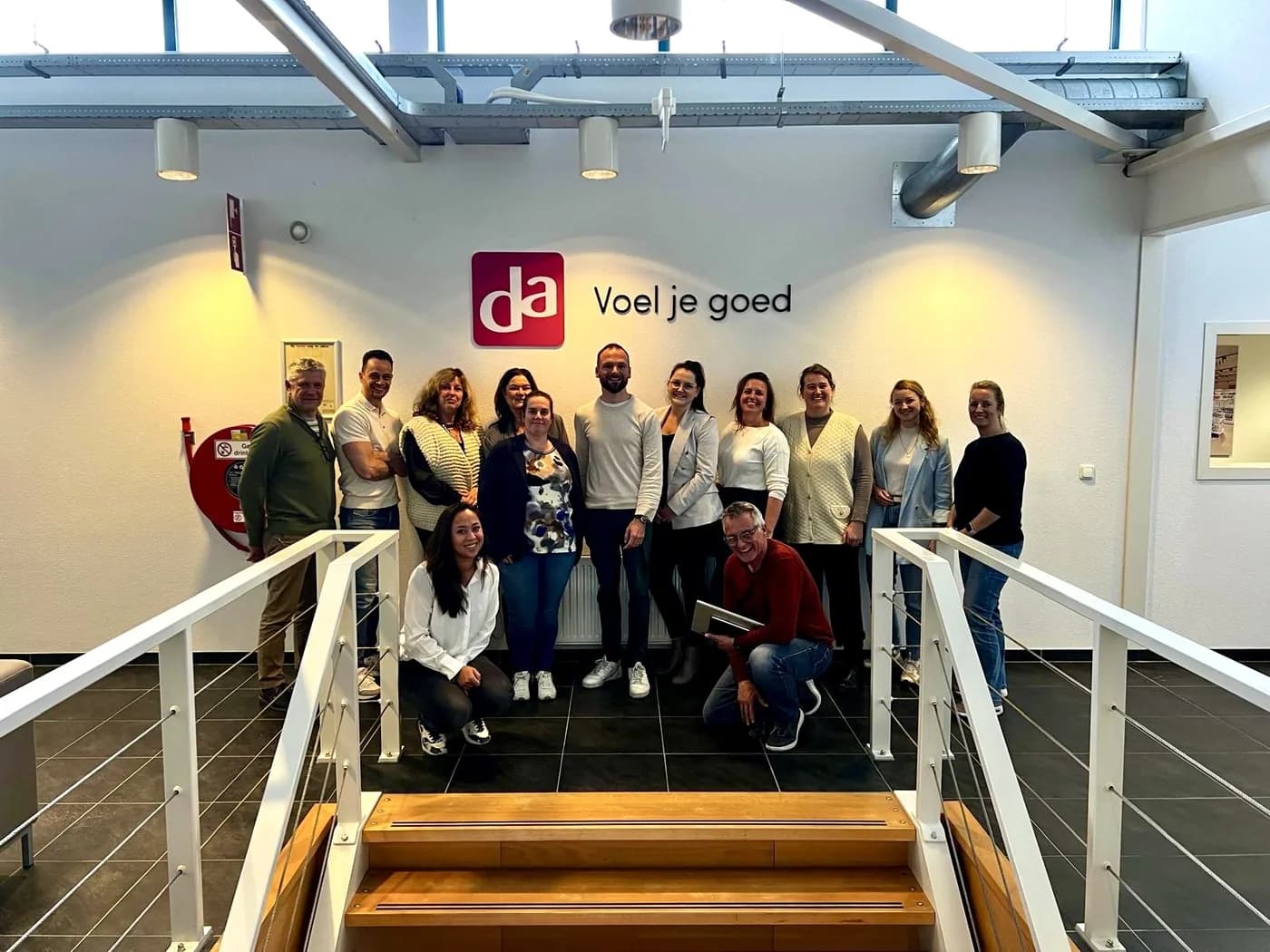
A team after an AI workshop by NinA AI

What is AI adoption?

AI adoption is the extent to which AI is actually used in day-to-day work. Not how many licences there are, but how much work is done differently.

That difference is bigger than it looks. An organization can switch on Copilot for everyone and still gain very little: a few colleagues use it for an email, the rest have forgotten it after two weeks. That's rolled out, not adopted.

It's adopted when the work itself changes. When a quote always starts from an AI first draft, when customer questions are prepared before anyone opens the ticket, and when the team comes up with ideas for the next process themselves.

Why does AI so often go unused?

Rarely because the tool is bad. Almost always for reasons that have to do with people and work. These are the seven we see most often:

  • No time to learn. The work goes on, and practising with AI will 'fit in later'. Later never comes.
  • Examples that aren't about your own work. A training with a pancake recipe doesn't help a buyer. People need to see it work on their own tasks.
  • A bad first experience. The first answer was wrong, and the verdict is in. If you understand why AI sometimes makes things up, you also know how to catch it.
  • Nobody knows what's allowed. Can customer data go in? Which account? Without house rules, one person does nothing and another uses the free version with sensitive data. See using AI safely.
  • Quiet worries about one's own job. 'If this works, am I still needed?' Nobody says it out loud, everybody thinks it.
  • No owner. IT rolled it out, the business waits and sees. Nobody feels responsible for the result.
  • Loose tools instead of processes. Everyone prompts for themselves. Useful, but the work itself doesn't change. For that you need workflows and agents.

Recognise a few? You're in good company. All the causes of failed AI projects are listed in why AI projects fail.

What goes on in people's heads?

In every team you roughly see three groups. A few enthusiasts who have been experimenting on their own for a while. A large middle group that is curious but doesn't know where to start. And a few sceptics, often the people with the most experience, who have seen three hypes come and go.

All three need something. The enthusiasts need room and direction, or they build things that never leave their own laptop. The middle group needs examples from their own work and time to practise. And the sceptics need to be taken seriously: they know exactly where the exceptions are, and once they're convinced, the rest follows.

The honest conversation about work

The question nobody asks out loud, you have to put on the table yourself. What will AI do, and what won't it do? For us the goal is almost always growth with the same team: AI takes over the work that now stays on the pile or gets done in the evening, so people get time for customers, quality and the work they're good at. Tasks change, and you can say so honestly. But if you don't have the conversation, you get rumours instead.

The four phases

Where do you stand?

Prompting, assistants, workflows, agents. Almost everyone is in phase one: loose prompts and personal gains. Only with workflows and agents does the work itself change. Click through the phases to see what each one asks and delivers.

Where are you? Click a phase.

What it looks like
People use ChatGPT or Copilot for an email or a summary. The handy ones save time, the rest watch.
What you need
Licences, a few ground rules and basic prompting skills.
What it delivers
Personal and hard to measure. The organization barely notices.

Our advice if you're here

Get your team to the same level in one afternoon. Then you'll see where work piles up.

How to go about it

Bring your team along in six steps.

No year-long change programme with posters in the canteen. Just six things you can start next week, in this order.

  1. 01

    Start with the work, and ask the people who do it

    It's not management that decides where AI will help, but the people who do the work. Ask where time leaks away: retyping, searching, reports, the same email for the twentieth time. People who name the opportunities themselves want them to succeed.

  2. 02

    Pick one process that hurts, together

    Not the biggest one, but one everyone recognises. A quick win with energy in the team beats a bigger but heavier project. Work out what it delivers: duration, number of people, frequency.

  3. 03

    Train on real tasks

    A workshop only works when people practise on their own work: their own quotes, their own customer emails. Start with good prompting, then an assistant of your own that knows the work.

  4. 04

    Create champions in every team

    One or two people per team who are a little further ahead and help their colleagues. Give them time and a direct line to whoever builds. A colleague at the next desk convinces more than any training.

  5. 05

    Agree on house rules and let people decide

    Which tools, which accounts, what can and can't go in. Write it down in a short AI policy. And keep a human in the loop: the AI proposes, the employee approves. That's how trust grows, step by step.

  6. 06

    Measure, share and keep going

    Measure against a baseline: how many hours did it take, how many now? Show every month what's running and what it delivers, and celebrate when a process goes live. Then the next one.

The difference

Rolling out or adopting?

Two organizations, the same licences. Six months later they are in very different places.

Rolling outAdopting
Starting pointA tool and licencesThe work and the people who do it
Who decides where AI helpsIT or the vendorThe team, with management as owner
TrainingOne general sessionOn real tasks, per role, with repetition
RulesNone, or a banHouse rules and business accounts
Role of peopleUnclearThe AI proposes, a person decides
Success measured inNumber of licencesHours saved against a baseline
After six monthsA few fans, the rest back to the old wayProcesses live and a team with ideas for the next one

What does it ask of leadership?

More than a budget. Three things make the difference:

  • Use it yourself. A management team that shows how it works with AI does more than a memo about the importance of innovation.
  • Make time. Learning takes a few hours per person. If that has to come on top of a full week, it won't happen.
  • Assign ownership. Per process, someone from the business who wants the result and makes the call. Not IT, not the vendor.

AI literacy is part of it, also by law

Since 2 February 2025, the AI Act has required organizations to ensure sufficient AI literacy among the people who work with AI. That's not a certificate, but a reasonable effort: knowing what it can do, what it can't and what to watch for. The good news: an approach aimed at adoption largely takes care of this. What the law asks exactly and how to arrange it per role is explained in AI literacy.

How do you measure whether AI is actually used?

Not by the number of licences or logins. By what changes in the work:

  • Hours saved per process, measured against the baseline from before the start. Three numbers per step: duration, number of people, frequency.
  • Processes that are live and run every day, not pilots sitting on a laptop.
  • How much work the AI may finish on its own. If an agent starts with every proposal checked and, after a few months, may handle the simple cases itself, trust is demonstrably growing. See human in the loop.
  • Ideas from the team. Do colleagues come up with the next process themselves? Then it has stuck.

How to calculate the return in euros is explained in making an AI business case.

How does NinA approach this?

Guiding people through the change is one of the three things that set us apart: that's where the real resistance is. We train, coach and create champions in every team. And because we have our own developers, we also build what we advise, so it doesn't stop at good intentions.

  • The AI Quick Scan, € 6,000 one-off. One day on site, with management, the team and the shop floor at the table. Within a week: a baseline on seven dimensions, a business case per opportunity and a twelve-month roadmap.
  • The AI Partnership, from € 4,500 per month, minimum twelve months. A dedicated team that builds, trains and shows every month what it delivers. Workshops are part of the programme. Guarantee: at least 2x back in the first year, or we don't start.
  • Separately, a talk or workshop: a talk for a large group (€ 2,450) or a hands-on workshop with your team (€ 4,500 per half day).

Frequently asked questions about AI adoption

How long before a team really works with AI?

You can learn prompting in an afternoon, but it only becomes a habit after weeks of practice on your own work. Workflows and agents go live process by process. In an AI Partnership we work in quarters: in the first quarter the team works with prompts and assistants and the first process goes into production, after that process after process follows the roadmap.

What if employees are afraid for their jobs?

Have the conversation, don't wait for the question. Explain what AI will and won't do and what the goal is. For us that is almost always growth with the same team: AI takes over the work that now stays on the pile. Involve the people who do the work from the start; those who name the opportunities themselves experience AI less as a threat.

What is an AI champion?

A colleague in each team who is a little further ahead with AI and helps others: shares examples, answers questions and passes ideas on to whoever builds. It's not a full-time role. Do give champions time and a fixed point of contact, or they end up doing it on top of all their work and it stops.

Should we train everyone at once?

No. Start with the team of the first process and with the champions. The rest follows, with examples from your own organization. For the AI Act, everyone who works with AI does need sufficient AI literacy; you arrange that per role.

Should we ban ChatGPT until everything is arranged?

Preferably not. A ban often means people use it secretly, with their personal account. Better: choose business accounts, agree on a few house rules about what can and can't go in, and write them down. How is explained in using ChatGPT safely.

Who should own AI in the organization?

Per process, someone from the business who wants the result, with management as the sponsor. IT is indispensable for access and security, but if IT is the only owner, it often stops at rolling out.

Bring your team along, without it becoming a year-long project?

In a fifteen-minute intro call we look at where you stand and which process is a good first step.

  1. 01

    Intro call

    Fifteen minutes, no strings. Where does work get stuck and what do you want to achieve?

  2. 02

    AI Quick Scan

    One day on site. Within a week, a business case and a roadmap.

  3. 03

    AI Partnership

    A dedicated team that builds, trains and shows what it delivers every month.

160+ organizations · Sessions rated 9.3 · Based in Amsterdam